
-
Tokyo Metropolitan Mita High School
- Level/s of EducationUpper SecondaryRegionKanto
- Main areas of activity No registration
| Location | 1-4-46, Mita, Minato-ku, Tokyo |
|---|---|
| TEL. | (+81)3-3453-1991 |
| Website | http://www.mita-h.metro.tokyo.jp/site/zen/ |
| Membership | 1960 |
2025 Annual Report
Biodiversity, Climate change, Environment, Cultural diversity, World heritage/intangible cultural heritage/regional cultural properties, International understanding, Peace, Human rights, Gender equality, Welfare, Sustainable production and consumption, Health, Dietary education, Poverty, Global Citizenship Education (GCED)
1 Activities Led by the UNESCO Committee
At our school, the UNESCO Committee operates under student leadership and is organized into several teams, including the Bazaar, Terakoya, Clothing, and New Projects teams.
During the Hakujusai School Festival, the committee conducted activities such as selling fair-trade products and organizing participatory programs for visitors, sharing the significance of international cooperation and fair trade with the school community. The proceeds and donations generated through these initiatives were directed toward international support efforts.
In addition, the committee has continuously implemented social contribution activities such as clothing donation drives and the collection of unused postcards. By providing opportunities to learn about the background of donations and the mechanisms of international aid, these activities have fostered in students a sense of responsibility and perspective as those who provide support, rather than those who receive it.
Furthermore, through lectures by representatives of international cooperation organizations and participation in off-campus programs, students have learned about current international affairs and humanitarian support activities, and have developed the ability to reflect on issues related to peace and human rights in their own words.
These activities are characterized not merely by participation in events, but by students taking responsibility for the entire process—from identifying issues and planning initiatives to implementation and reflection—and are positioned as practices that embody the spirit of UNESCO.
2 Implementation of Global Citizenship Day (for First-Year Students)
As part of an initiative to extend UNESCO-based learning throughout the entire school, a “Global Citizenship Day” was held for first-year students.
In the first half of the program, workshops using UNESCO Recommendation-based card teaching materials were conducted in each class. First-year UNESCO Committee members served as facilitators, while second- and third-year committee members provided guidance from the planning stage onward. Together, they prepared the program by collaboratively examining discussion questions, workshop flow, and worksheet design.
Through experiential activities and dialogue that allowed students to engage with diversity, participants explored questions such as “What kind of peace and human rights does UNESCO seek to promote?” and “What does it mean to be a global citizen?” This provided an opportunity for each student to connect these ideas with their own actions and choices.
In the second half of the program, a special lecture featuring music and video was delivered by Dr. Norihiko Kuwayama, a physician and the representative of the NPO Stage of the Earth. Drawing on his experiences providing medical support in conflict zones and disaster-affected areas, his message encouraged students to reconsider distant global issues as matters of personal relevance. His words—“There is no one who is unrelated”—left a deep and lasting impression on the students.
3 Promotion of Community Collaboration and Off-Campus Activities through Cooperation with the Minato UNESCO Association
Our school maintains an ongoing partnership with the Minato UNESCO Association, a local organization that promotes UNESCO-related activities, and actively incorporates opportunities for off-campus learning and community collaboration.
In the 2025 academic year, students participated not only in lectures and multicultural understanding workshops organized by the Minato UNESCO Association, but also engaged in volunteer activities supporting the operation of events such as speech contests and symposiums.
Through lectures, students deepened their understanding of the “culture of peace” advocated by UNESCO, reflecting on contemporary issues such as armed conflicts and the rise of nationalism.
In multicultural understanding workshops, students collaborated with university students and local participants, engaging in dialogue on themes such as cultural superiority and differences in values, and considering ways in which diverse cultures can coexist in society.
Furthermore, by participating as volunteers in speech contests and symposiums, students experienced international understanding and peace-related initiatives from the perspective of those who support and sustain such efforts. This helped foster an awareness of their role as members of the local community.
Through these experiences, students expressed reflections such as realizing that their own values are not absolute, and recognizing the importance of dialogue rather than imposing a single sense of justice. These activities provided meaningful opportunities to gain a tangible understanding of the principles of the UNESCO Charter.
4 Promotion of School-Wide International Understanding Education
In addition to the activities of the UNESCO Committee, the school as a whole has implemented initiatives aimed at fostering international understanding and social contribution awareness.
These include international understanding lectures delivered by representatives of international cooperation organizations, as well as English Rakugo performances, which have provided opportunities to learn about global issues while also reflecting on cultural exchange and the significance of expressing ideas across languages.
Moreover, through on-campus displays, lectures, and activities conducted during homeroom sessions, the school has continuously disseminated information and promoted awareness related to international understanding and social contribution.
As part of the school trip program, students visited Taiwan, where they engaged in experiential learning and exchanges that allowed them to encounter different cultures, histories, and values firsthand.
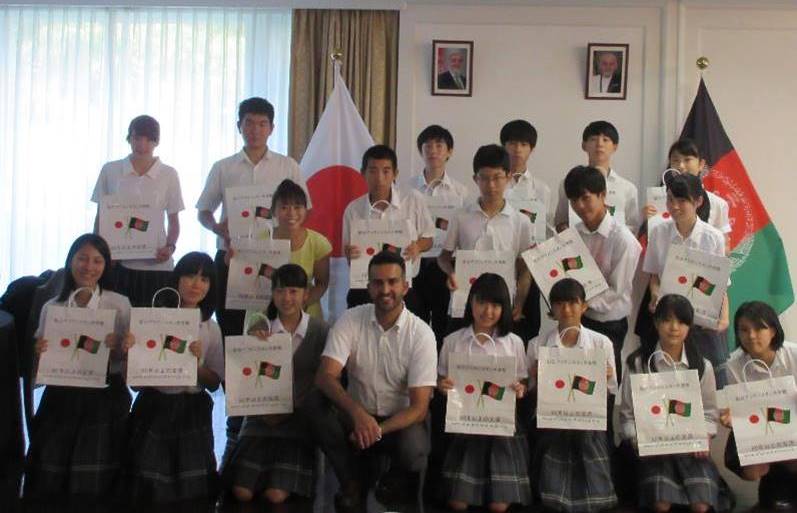
In addition, an embassy visit is planned, with the aim of broadening students’ perspectives as members of the international community by providing opportunities to learn about diplomacy and international relations in practice.
5 Development of UNESCO-Based Learning through Inquiry Activities
At our school, inquiry-based learning is conducted in the first and second years, with many projects focusing on the SDGs, international issues, and social challenges.
By formulating their own research questions and engaging in investigation, analysis, and presentation, students have addressed a wide range of topics, including environmental issues, poverty, education, gender equality, health, and the relationship between sports and society.
One of the defining features of the 2025 academic year is the way perspectives and awareness cultivated through UNESCO Committee activities have extended into inquiry learning, while insights gained through inquiry activities have, in turn, been reflected back into committee initiatives. This reciprocal relationship has created a school-wide cycle of UNESCO-based learning.
Annual Work Plan
In the 2026 academic year, our school aims to build on its ongoing efforts as a UNESCO Associated School, while continuing to value student-led activities and deepening learning related to international understanding and social participation in ways that feel meaningful and authentic to students.
Committee activities, school events, inquiry-based learning, and collaboration with external organizations will each be carried out within their respective frameworks, with continued efforts to ensure that students’ interests and insights lead naturally to further learning.
1. Continuation and Enhancement of UNESCO Committee Activities
Student-led planning and management within the UNESCO Committee will continue to be emphasized. Through activities such as bazaars, social contribution projects, and lectures, students will be provided with ongoing opportunities to engage with social issues including international cooperation, peace, and human rights.
In addition, importance will be placed on opportunities for students to share the purposes and backgrounds of these activities with one another and to reflect on their experiences, with the aim of deepening learning through committee activities.
2. School-wide Initiatives for International Understanding
School events such as Global Citizenship Day, international understanding lectures, and English rakugo performances will be conducted to provide students with opportunities to encounter diverse values and perspectives.
School displays and homeroom activities will also be utilized to continuously offer occasions for students to think about international understanding and social issues.
3. Relationship with Inquiry-Based Learning
Inquiry-based learning will continue to address themes related to the SDGs and international issues, fostering students’ ability to develop an interest in social challenges and to formulate and explore their own questions.
When appropriate, topics and perspectives addressed in UNESCO Committee activities and international understanding events will be shared within inquiry-based learning, helping students to recognize connections among different learning experiences.
4. Collaboration with External Organizations and the Local Community
Collaboration with external organizations and the local community, including the Minato UNESCO Association, will be continued. Opportunities for learning outside the school will be ensured through participation in lectures, multicultural understanding workshops, speech contests, symposiums, and volunteer activities.
International understanding programs such as overseas visits during school trips and visits to embassies will also be valued as opportunities for students to broaden their perspectives and deepen their learning through direct experience.