
-
Jiyunomori Gakuen Junior & Senior High School
- Level/s of EducationSecondaryRegionKanto
- Main areas of activityBiodiversity, Oceans, Disaster reduction/prevention, Climate change, Energy, Environment, Cultural diversity, World heritage/intangible cultural heritage/regional cultural properties, International understanding, Peace, Human rights, Gender equality, Welfare, Sustainable production and consumption, Health, Dietary education, Poverty, Biosphere reserves, Geoparks, Global Citizenship Education (GCED)
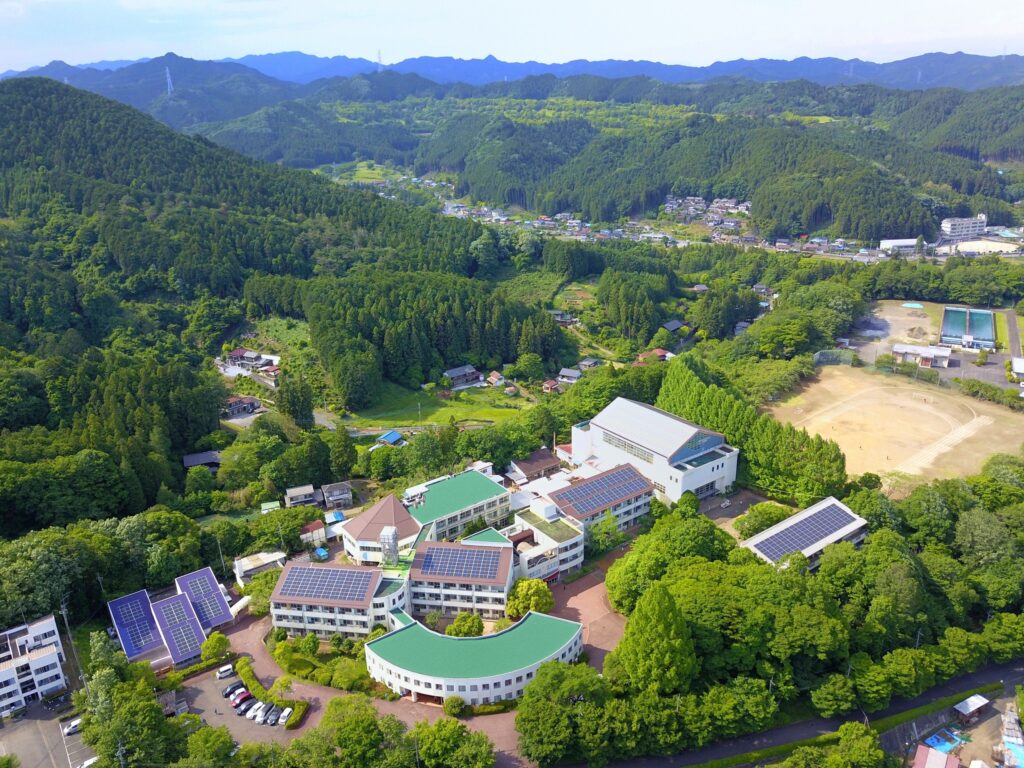
自由の森学園遠景
| Location | 613, Koiwai, Hanno-shi, Saitama |
|---|---|
| TEL. | (+81)42-972-3131 |
| Website | https://www.jiyunomori.ac.jp/ |
| Membership | 2017 |
2025 Annual Report
Biodiversity, Oceans, Disaster reduction/prevention, Climate change, Energy, Environment, Cultural diversity, World heritage/intangible cultural heritage/regional cultural properties, International understanding, Peace, Human rights, Gender equality, Welfare, Sustainable production and consumption, Health, Dietary education, Poverty, Biosphere reserves, Geoparks, Global Citizenship Education (GCED), Other related areas
Goals and Content:
To recognize the connections between global environmental issues, local and school-level challenges, and oneself, and to gain experience in solving them through one’s own actions. Jiyunomorigakuen’s ESD framework is broadly divided into two pillars: educational practice and school management.
The former, educational practice, centers on our junior high school’s original integrated study program called “Forest Time” and elective high school classes, while also incorporating student-led initiatives such as the Sustainability Committee.
What We Value:
1. To foster the recognition that what is happening in Japan and around the world is not someone else’s problem, but our own problem. This is an element common not only to climate change, but to all global issues such as peace and poverty. Imagination and empathy for people separated by time and space are necessary, and cultivating these abilities is inseparable from gaining accurate knowledge.
2. To foster an attitude of taking personal initiative, rather than relying on others to act.
3. To visit the site firsthand whenever possible, observing with one’s own eyes, listening to diverse perspectives, and learning through direct experience.
4. Beyond educational practices for students, schools’ concrete commitment to ESD – such as achieving decarbonization – is essential to making education truly meaningful. Rather than simply entrusting the future of the global environment to children, we believe that if adults and schools take up the issue seriously now, we can move beyond environmental education as a mere formality and become a driving force for building the future.
Management practices that allow schools to steer toward decarbonization- while maintaining a business balance without excessive investment – demonstrate that international decarbonization goals are indeed achievable. We believe that the decarbonization of management at educational institutions is not merely a management policy, but in itself a vital practice of education and ESD.