
| Location | 1250, Oshitate, Inagi-shi, Tokyo |
|---|---|
| TEL. | (+81)42-377-4443 |
| Website | https://www.fureai-cloud.jp/ine4e/ |
| Membership | 2013 |
2025 Annual Report
Environment, Cultural diversity, International understanding
Our school promotes educational activities under the theme: “Students of Inagi 4th elementary who grow with the community and take flight into the world.” Through rich interactions with local residents, we aim to nurture in our students a sense of pride in their hometown and foster individuals who will contribute to a sustainable society and thrive as global citizens. Through the practice of ESD, we place particular emphasis on developing students’ communication skills.
Exchange Program with Students from Singapore
(5th & 6th Grade – Foreign Language, Classroom Activities, Integrated Studies)
Sixteen students and eight staff members from Huamin Primary School, a UNESCO School in Singapore, visited our school for an exchange program.
Preparation
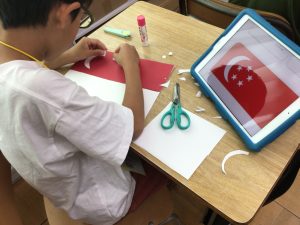
In foreign language classes, students learned about Singapore and created welcome flags and posters.
Fifth graders prepared self-introductions, while sixth graders worked on presentations to share the魅力 of Inagi City and Japan. After presenting in their homerooms, representatives were selected from each class, and they practiced repeatedly with guidance from the ALT in preparation for the event.
Welcome Reception
The students from Singapore entered the hall to a welcome performance by the Japanese drum club. Our students then delivered a welcome speech in English.
Fifth graders introduced themselves in English, and sixth graders gave presentations about Inagi City, as well as Japan’s four seasons and culture, applying what they had learned in foreign language classes.
Afterward, everyone watched an introduction video about Huamin Primary School, and the visiting students performed Singaporean songs and dances.
Recess
Students were divided into small groups to tour the school and play in the schoolyard. One local volunteer interpreter was assigned to each group. Using the English they had learned, along with gestures, students enjoyed communicating with one another.
Classroom Exchange Activities
During class meetings, students discussed how they could become friends with the visiting students and planned activities accordingly.
Each class engaged in enjoyable exchanges, such as introducing Japanese culture through traditional games, playing gesture-based quizzes, and balloon volleyball—activities that did not require much language.
Students shared comments such as, “He said he’s good at playing the piano!” and “Soccer is popular in Singapore too.”
Through these interactions, students experienced the joy of using English and discovered similarities with their new friends, making the international exchange meaningful and fulfilling.
Lunch
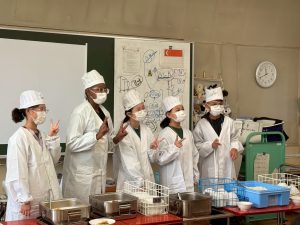
During lunchtime, the Singaporean students wore the white uniforms used for serving school meals and helped with the meal distribution.
Since students in Singapore do not prepare meals themselves, they found the weight of the dishes and the serving process both challenging and enjoyable.
Our students supported them by preparing the serving tables.
Through this experience, our students realized that what is ordinary for them can be new and surprising to others, and they gained a renewed appreciation for the strengths of Japanese school culture.
Annual Work Plan
1. Quantitative Evaluation from an ESD Perspective
As we continue our lessons and daily initiatives, we will carry out quantitative evaluations based on the principles of Education for Sustainable Development (ESD). These evaluations will help us refine our teaching approaches and improve our curriculum. In ESD‑related learning—especially during the Period for Integrated Studies—both teachers and students will complete simple before‑and‑after assessments so that changes in learning can be clearly seen. Similar evaluations will also be conducted several times throughout the year during everyday school activities, allowing us to reflect on our practices and make ongoing improvements.
2. Enhancing Activities and Instruction through Special Activities
Our school’s research goal for Special Activities is “To nurture students who engage in thoughtful, proactive discussions to create better classes and a better school.” Building on this research, we aim to help students develop and express their own ideas through an ESD lens. We will support students in taking initiative as they discuss and work toward solving familiar issues related to the school, community, and environment. At the same time, we hope they will learn to appreciate diverse perspectives and experience the joy of working together to build a better class, school, and society.