
-
Center for Early Education and Care, Angel Kindergarten
- Level/s of EducationKindergartens, Certified Centers for Early Childhood Education and CareRegionChugoku/Shikoku
- Main areas of activityBiodiversity, Oceans, Climate change, Energy, Environment, Cultural diversity, World heritage/intangible cultural heritage/regional cultural properties, International understanding, Peace, Human rights, Gender equality, Welfare, Sustainable production and consumption, Health, Dietary education, Global Citizenship Education (GCED), Other related areas
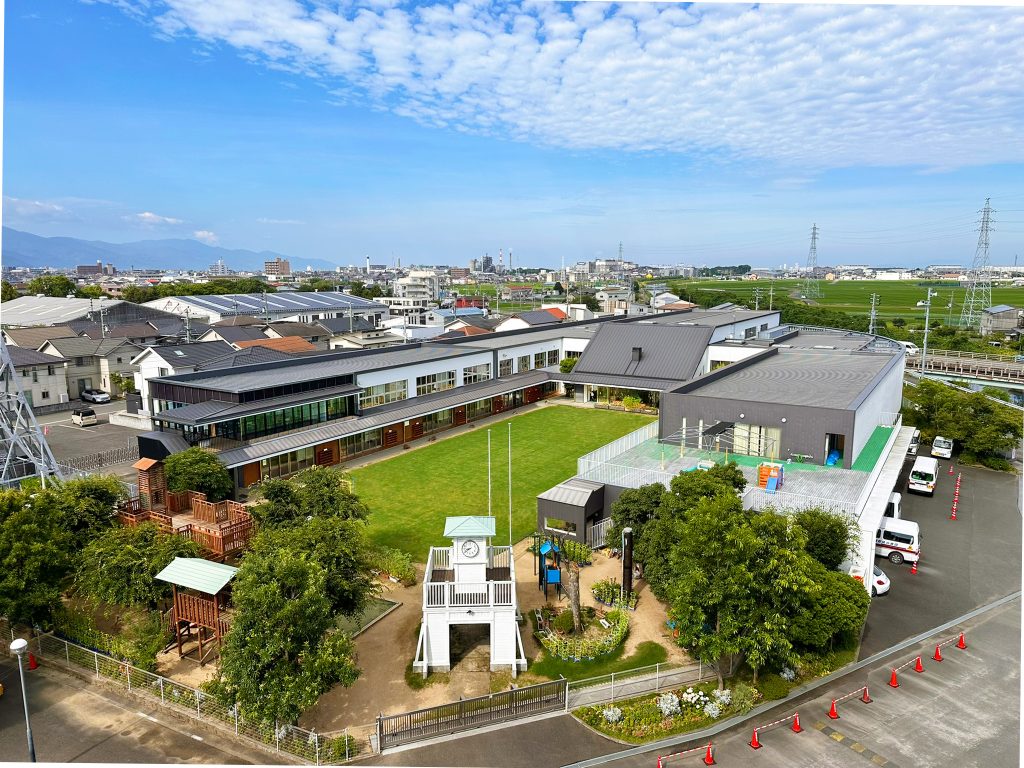
| Location | 561-1 Nishikoizumi, Masaki-cho, Iyo-gun, Ehime Pref. 791-3134 JAPAN |
|---|---|
| TEL. | (+81)89-984-6411 |
| Website | https://www.angel-gakuen.ac.jp/english/ |
| Membership | 2025 |
2025 Annual Report
Biodiversity, Climate change, Environment, Cultural diversity, World heritage/intangible cultural heritage/regional cultural properties, International understanding, Peace, Human rights, Gender equality, Welfare, Sustainable production and consumption, Health, Dietary education, Global Citizenship Education (GCED)
At our kindergarten, our educational goal is leading children to grow up strong, bright, and with a tender heart. We place particular emphasis on sensory-rich experiences in our education and care. In 2025, we carried out various ESD practices, of which four key activities are outlined below.
- International Exchange (Taiwan/Kaohsiung City Private Global Village Kindergarten, Australia/Sesame Lane Care and Kindergarten)
To promote international understanding, we facilitated two online international exchange programs. Collaborated with a kindergarten in Taiwan, to experience “Dragon Boat Festival,” one of their three major traditional holidays. Also organized an event with an Australian kindergarten to introduce Japan’s “Children’s Day.” These initiatives successfully fostered cross-cultural interest and mutual respect.
-300x225.jpg)
-300x225.jpg)
-300x225.jpg)
- Tea Picking and Processing Experience
As a learning opportunity connecting environment, culture, and food education, children participated in tea-picking at a local tea field and tea-kneading activities back at the kindergarten. Through these experiences, they developed awareness of the people and nature behind familiar foods and enjoyed expressing themselves by designing original tea labels.
-300x225.jpg)
-300x200.jpg)
-300x200.jpg)
- Collecting Pull Tabs to Donate Wheelchairs
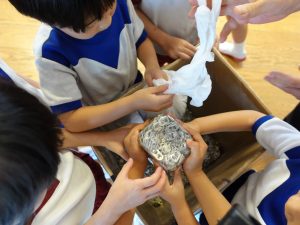
Since 2016, we have continued an initiative that turns collected aluminum pull tabs from home into wheelchairs. As part of our efforts in welfare, environmental awareness, and responsible consumption, families engaged in pull-tab collection and children experienced using wheelchairs, fostering empathy and an understanding of resource circulation. The 8th wheelchair is scheduled to be donated in February.
-300x225.jpg)
-300x225.jpg)
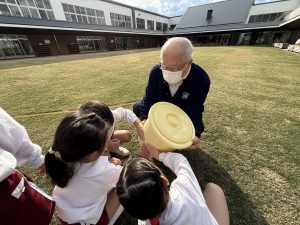
- Miso-Making Project Linking Children, Families, and the Community
Utilizing locally grown hadakamugi (naked barley), we implemented a comprehensive food education project titled “The Story of “Misomaru” Sprouting from Naked Barley.” The project included:
- April: Exploring the barley fields
- July: Participating in a miso-making workshop with a craftsman from the local company “Gino Miso.”
- July–September: Observing changes in taste and aroma through fermentation
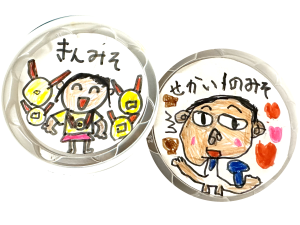
- September: Creating original “My Miso Labels” infused with each child’s feelings
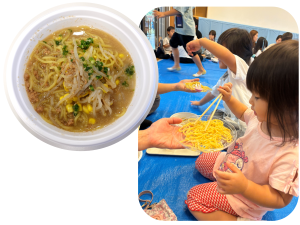
- October: Serving miso ramen at our art exhibition and autumn bazaar; miso shared with families
- November: Gifting miso to local senior welfare facilities
This project was highly commended at the 20th “Food Education Contest” hosted by the NPO Early Childhood Education and Childcare Support Promotion Organization (with support from the Ministry of Education, Culture, Sports, Science and Technology [MEXT] , Ministry of Agriculture, Forestry and Fishers [MAFF], Children and Families Agency and others), and we were honored to be awarded the Minister of Education, Culture, Sports, Science and Technology’s Prize.
2-300x225.jpg)
2-300x225.jpg)
2-300x225.jpg)
Annual Work Plan
Building upon the achievements of this year, we will continue in 2026 to promote learning where children actively engage with nature, society, and culture. In collaboration with families and the community, we will further cultivate children’s abilities to become creators of a sustainable society across key ESD fields: environment, cultural diversity, regional heritage, international understanding, peace, welfare, sustainable production and consumption, health, and food education,etc. In particular, we plan to welcome students who are studying education and childcare at both National Tsing Hua University and National University of Tainan in Taiwan, through collaboration with Ehime University. This will offer children a valuable opportunity to experience diverse international cultures and values.