
| Location | 1-13-23, Nyoidani, Minoo-shi, Osaka |
|---|---|
| TEL. | (+81)88-653-4872 |
| Website | https://www.assumption.ed.jp/primary/ |
| Membership | 2017 |
2025 Annual Report
Biodiversity, Oceans, Disaster reduction/prevention, Climate change, Environment, Cultural diversity, International understanding, Peace, Human rights, Gender equality, Welfare, Sustainable production and consumption, Health, Dietary education, Poverty, Global Citizenship Education (GCED)
Our school operates under the motto of “Sincerity, Love for Others, and Joy,” implementing programs in “International Understanding,” “Food Education,” and “Service Activities.” Furthermore, through the three key areas emphasized by UNESCO Associated Schools, we aim to cultivate the ability to collaborate with others and contribute to world peace. Within this framework, we view ESD as “a mission fulfilled by each child” and have carried out the following specific activities:
1. Cultivating “Global Citizens” through Systematic Inquiry Activities
Each grade level conducted inquiry-based learning centered on “The Cycle of Life,” “International Understanding,” and “World Peace.” Lower grades began by fostering awareness of life in their immediate surroundings, while upper grades progressed to activities where students personally engaged with global issues like conflict and poverty. Beyond mere knowledge acquisition, students continually questioned what roles they could play as members of society. This fostered an attitude of seeking peace from multiple perspectives.
2. Exploring a Sustainable Future Society through External Collaboration
Representative students participated in the Asia-Nordic ASPnet International Forum hosted by “Osaka-Kansai ASPnet.” They discussed concrete proposals for building a sustainable future society alongside diverse generations, including junior high and high school students. Through this exchange, the children realized the importance of articulating and communicating their own ideas, as well as the challenges and joys of collaborating with others from different backgrounds to derive solutions. This experience served as a significant stimulus not only for the participating children but for all students in the school who received the reports.
3. Practical Service Activities and Social Contribution
Continuous donation activities were carried out throughout the year. The collected funds were delivered to those in need both domestically and internationally, allowing students to tangibly practice “love for one’s neighbor”—understanding that their actions support others. Additionally, the “Power of Clothes Project” (in partnership with UNIQLO), led primarily by fourth graders, called for used clothing donations throughout the school to be delivered to refugee children. Students experienced the cycle where their own possessions support someone else’s life in the world, connecting this understanding to concrete actions for addressing challenges.
4. Understanding the “Cycle of Life” through Food Education
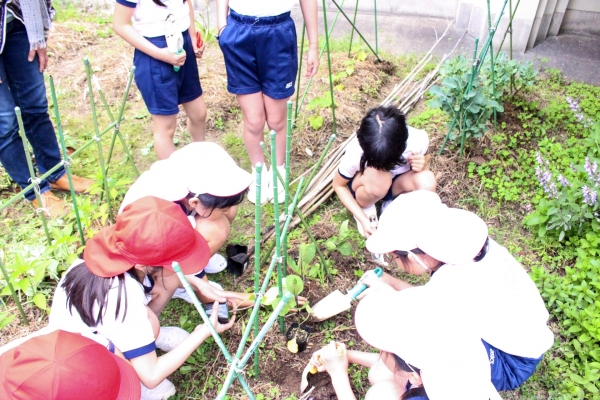
In food education classes, students learned that the meals we eat daily are supported by many lives. They deeply examined not only environmental considerations like gratitude toward producers and reducing food waste, but also how life connects and cycles. This learning directly nurtured a heart that values their own and others’ lives, laying the foundation for the “sincere” way of living cherished by our school.
Annual Work Plan
Next year, we will build upon the child-led problem-solving approach seen this year while reconstructing the systematic curriculum that was a challenge. We will revamp the ESD calendar to avoid isolated events, consciously creating vertical connections across all six grades and structurally placing opportunities for children to personally engage with global issues.
Specifically, through ongoing teacher training, we will create cross-curricular projects, increasing opportunities for students to proactively consider and act on “what they can do now for the world.” We will expand practices like the 4th-grade “Power of Clothing Project” into whole-school learning and establish mechanisms to feed insights gained from external collaborations, such as international forums, back into the school’s inquiry activities. We will also internalize activities like ongoing donations and food education by regularly questioning their significance with students and conducting reflections. We will systematically cultivate “children who can contribute to the world”—individuals capable of developing problem awareness at diverse levels, collaborating with others, and acting as creators of a sustainable society.